

The LEED criteria
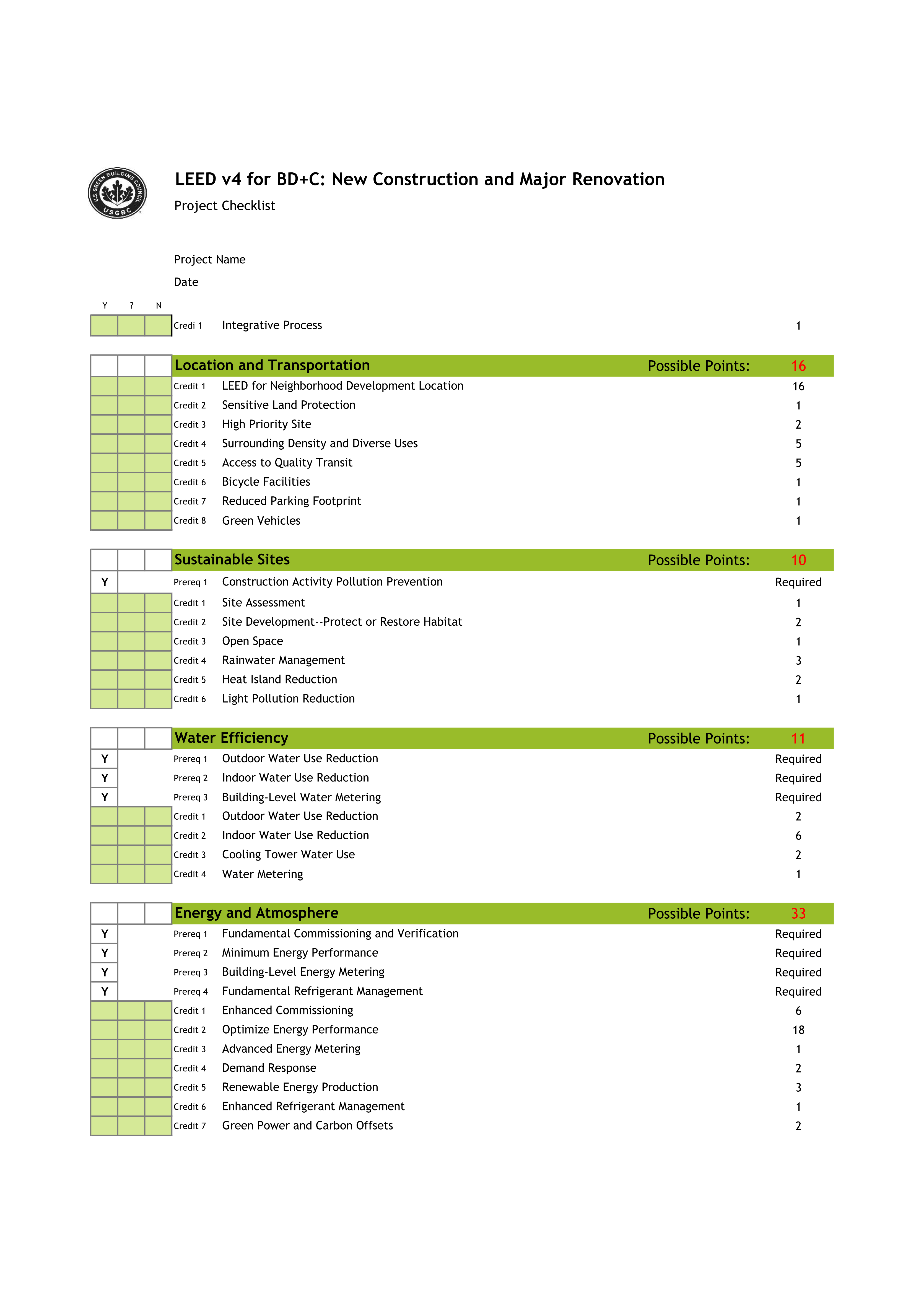 The LEED criteria
What is the difference between credits, points and prerequesites?
LEED certification is assessed in 9 environmental categories, which are made up of the various LEED criteria – Prerequesites and Credits. The fulfillment of the credits is assessed with points. Depending on whether it is a new building, an existing building or a renovation, an adapted LEED certification system is offered, in which the assessment criteria differ. The most commonly used system is LEED New Construction & Major Renovation (see table below). A maximum of 110 points can be achieved here.
Prerequesites are minimum criteria that must be met for certification. They are the basic prerequisite for certification, so no points are awarded for meeting these criteria.
Credits can be fulfilled in the various environmental categories in addition to the Prerequesites. There are no specifications for the selection of credits; the criteria that match the project can be freely selected. The fulfillment is scored and thus significantly influences the result of the certification.
LEED certification – The most important facts at a glance
- LEED stands for Leadership in Energy and Environmental Design and is the world’s leading rating system for sustainable construction
- LEED certification is internationally recognized and stands for environmentally friendly, energy-efficient and healthy buildings
- Suitable for all building types and construction phases: New build, interior fit-out, operation, maintenance or partial fit-out
- Advantages: lower operating costs, higher energy efficiency, better indoor air quality and long-term increase in the value of the property
- The USGBC offers an online tool to help you find the right LEED system for your project
How many points must be achieved for LEED certification?

LEED certification is based on the percentage of the possible total number of points achieved. A degree of fulfillment of at least 36% or 40 points is required for the “Certified” award. At least 45% or 50 points are required for the “Silver” award, at least 55% or 80 points for the “Gold” award and at least 73% of the total number of points or 80 points for the highest “Platinum” award.
Which environmental categories are assessed for LEED certification?
LEED certification evaluates 9 different categories. The various assessment areas support a holistic, sustainable approach to the planning, construction and operation of environmentally friendly buildings that focuses on people and users.
The share of the individual environmental categories in the overall assessment is broken down as follows:

The environmental categories are divided into mandatory prerequisites and voluntary credits for the evaluation (see criteria catalog below). In addition, points can be achieved in the RP – Regional Priority Credits category for criteria of particular importance to the location.
| Criteria LEED v4 for BD+C: New Construction and Major Renovation | |
| Integrative Process – integrative planning process | |
| Credit 1 | Integrative Process |
| Location/Transportation – infrastructural integration of the location | |
| Credit 1 | LEED for Neighborhood Development Location |
| Credit 2 | Sensitive Land Protection |
| Credit 3 | High Priority Site |
| Credit 4 | Surrounding Density and Diverse Uses |
| Credit 5 | Access to Quality Transit |
| Credit 6 | Bicycle Facilities |
| Credit 7 | Reduced parking footprint |
| Credit 8 | Green Vehicles |
| Sustainable Sites – Sustainable location / property qualities | |
| Prereq 1 | Construction Activity Pollution Prevention |
| Credit 1 | Site Assessment |
| Credit 2 | Site Development-Protect or Restore Habitat |
| Credit 3 | Open Space |
| Credit 4 | Rainwater Management |
| Credit 5 | Heat Island Reduction |
| Credit 6 | Light Pollution Reduction |
| Water Efficiency – Water efficiency | |
| Prereq 1 | Outdoor Water Use Reduction |
| Prereq 2 | Indoor Water Use Reduction |
| Prereq 3 | Building-Level Water Metering |
| Credit 1 | Outdoor Water Use Reduction |
| Credit 2 | Indoor Water Use Reduction |
| Credit 3 | Cooling Tower Water Use |
| Credit 4 | Water Metering |
| Energy and Atmosphere – Energy and global environmental impacts | |
| Prereq 1 | Fundamental Commissioning and Verification |
| Prereq 2 | Minimum Energy Performance |
| Prereq 3 | Building-Level Energy Metering |
| Prereq 4 | Fundamental Refrigerant Management |
| Credit 1 | Enhanced Commissioning |
| Credit 2 | Optimize Energy Performance |
| Credit 3 | Advanced Energy Metering |
| Credit 4 | Demand Response |
| Credit 5 | Renewable Energy Production |
| Credit 6 | Enhanced Refrigerant Management |
| Credit 7 | Green Power and Carbon Offsets |
| Materials and Resources – Material cycles and resource conservation | |
| Prereq 1 | Storage and Collection of Recyclables |
| Prereq 2 | Construction and Demolition Waste Management Planning |
| Credit 1 | Building Life-Cycle Impact Reduction |
| Credit 2 | Building Product Disclosure and Optimization – Environmental Product Declarations |
| Credit 3 | Building Product Disclosure and Optimization – Sourcing of Raw Materials |
| Credit 4 | Building Product Disclosure and Optimization – Material Ingredients |
| Credit 5 | Construction and Demolition Waste Management |
| Indoor Environmental Quality – Indoor (air) quality and comfort | |
| Prereq 1 | Minimum Indoor Air Quality Performance |
| Prereq 2 | Environmental Tobacco Smoke Control |
| Credit 1 | Enhanced Indoor Air Quality Strategies |
| Credit 2 | Low-Emitting Materials |
| Credit 3 | Construction Indoor Air Quality Management Plan |
| Credit 4 | Indoor Air Quality Assessment |
| Credit 5 | Thermal Comfort |
| Credit 6 | Interior Lighting |
| Credit 7 | Daylight |
| Credit 8 | Quality Views |
| Credit 9 | Acoustic Performance |
| Innovation | |
| Credit 1 | Innovation |
| Credit 2 | LEED Accredited Professional |
If you would like to find out more about our services, clicking on the relevant item in the table will take you directly to a detailed explanation of the respective criterion. We are, of course, always available for general advice.
The entire LEED v4 for Building Design and Construction manual is available through the USGBC.
Phone +49 711 62049-340
Email info@hoinka.com